WooCommerce LinkedIn conversion tracking needs an Insight Tag connection and a purchase conversion that matches the action your shop reports. Adding the tag alone does not establish purchase tracking. If you also send purchases through Conversions API, check the server rule and shared event identity separately.
Novra Tracking for WooCommerce and LinkedIn brings the documented Insight Tag connection and optional server purchases into WordPress. Its LinkedIn integration covers purchase, add-to-cart, checkout and sign-up conversions. The server route can reduce reliance on buyers returning after payment. It does not guarantee that every order receives credit in an ad report.
Identify the LinkedIn purchase path
A conversion is an action you want to measure, such as a purchase. LinkedIn separates the source sending that action from the rule that defines it. Record the intended account, shop domain and purchase rules before changing an existing connection.
| Part | Its job | Do not substitute |
|---|---|---|
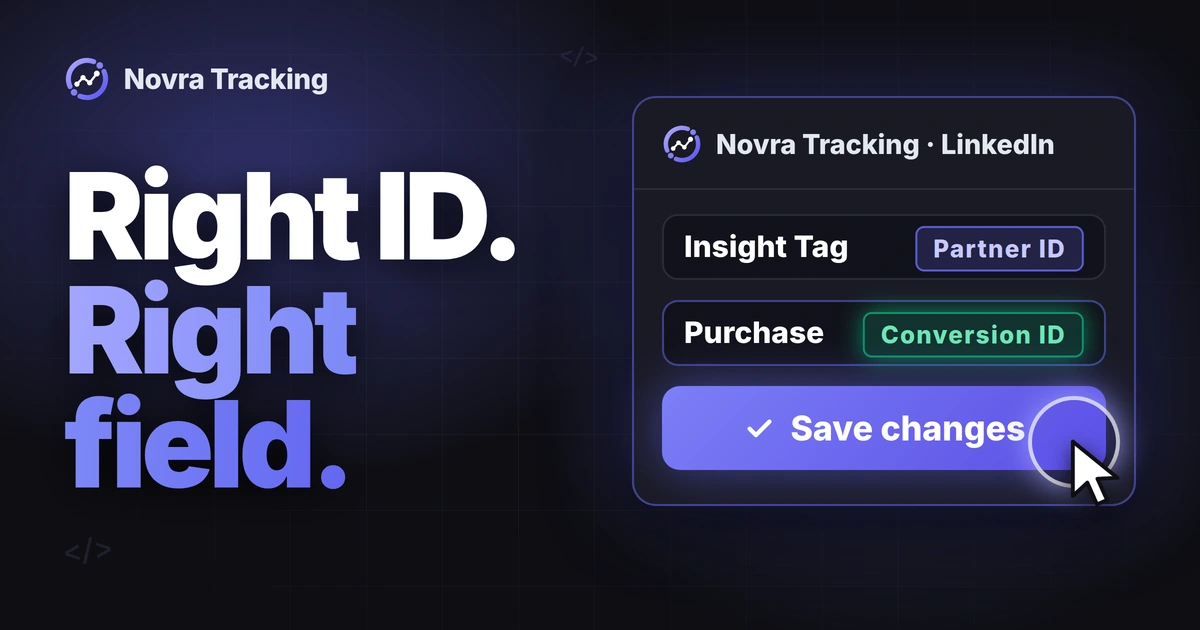
| Insight Tag and Partner ID | The browser script and the identity connecting its data to the intended advertising setup. | An ad account number or purchase conversion ID. |
| Insight Tag purchase conversion | The browser rule for the purchase action you intend to count. | A general page visit or a checkout-start rule. |
| Conversions API purchase conversion | The rule receiving the corresponding server purchase. | The Partner ID or an unrelated conversion. |
| Access token | A private credential authorizing the server connection. | An event ID or proof of successful delivery. |
LinkedIn’s Insight Tag overview explains the Partner ID and tag sharing across accounts. Reuse an appropriate existing tag when planning a plugin change. Do not create another tag simply because a conversion is missing.
List current senders: tracking plugins, theme snippets, Google Tag Manager and server integrations. Tag Manager manages tracking scripts; its presence does not show which actions it sends. Give each action and destination one clear owner. That owner may deliberately coordinate browser and server reports. Preserve unrelated campaigns, analytics and working integrations during any handover.
This guide uses Novra Tracking, a separate Novra Code product, not an official LinkedIn or WooCommerce extension. LinkedIn social login, Lead Gen Forms, CRM connections and campaign management are different requirements. Do not assume that purchase tracking supplies those features.
Prepare access and connect Novra
You need WordPress permission to install and configure the plugin, plus authorized access to the intended LinkedIn account, tag and conversions. Have the account owner resolve missing permissions. Do not use credentials from another business.
For API access, LinkedIn documents the rw_conversions and r_ads permissions. Its eligible account roles include Account Billing Admin, Account Manager, Campaign Manager and Creative Manager. These are API access requirements, not proof that your installed connection is authorized.
Novra documents WordPress 6.4+, PHP 8.0+ and WooCommerce 8.0+, including classic and block checkouts. Confirm your particular gateway and checkout extensions separately. Identify the cookie banner and the person responsible for its marketing permission.
Begin with a read-only review. Rehearse configuration on an isolated shop with a separately controlled LinkedIn destination. Before generating activity, have its operator confirm separation from production reporting, audiences and optimization. A payment gateway’s test mode alone does not provide that separation.
- Identify the tag. In the intended LinkedIn ad account, open Measure → Signals manager → Insight Tag. Record its Partner ID and account association.
- Install Novra if needed. In WordPress, use Plugins → Add New Plugin → Upload Plugin to install and activate your Novra ZIP.
- Connect LinkedIn. Open Novra Tracking → Settings, select LinkedIn, switch it on and enter the intended tag identity. Match the installed field to the Partner ID, not a purchase rule.
- Check the shop and consent. Review Shop & Events under Store, then Consent under Privacy. Confirm the detected banner and the required marketing choice.
- Review readiness. Read Novra Tracking → Dashboard recommendations. A saved ID or setup score does not prove that LinkedIn received a purchase.
The Novra platform-connection guide documents these WordPress controls. Google Tag Manager is not required. Do not add a second manual Insight Tag alongside the plugin without an explicitly designed reason.
Match the rule to a paid order
Order creation, checkout and payment are different actions. WooCommerce’s order-status guide distinguishes pending payment from a paid order awaiting fulfillment. Check what your gateway actually records, especially for delayed payments.
In Campaign Manager, open Measure → Conversion tracking and inspect the existing purchase conversion. Record its source, category, tracking method, value settings and selected ad sets. An ad set is the advertising group to which the conversion is associated. A second purchase rule can overlap an existing one.
Choose the browser conversion method
LinkedIn’s Insight Tag conversion setup distinguishes page-load and event-specific methods. A page-load rule matches a URL visit. An event-specific rule matches a reported action. A thank-you-page visit does not, by itself, prove payment or cover a buyer who never returns.
Novra describes one LinkedIn conversion per action. For its purchase action, identify the corresponding browser purchase conversion and enter that conversion’s ID in the appropriate installed control. Do not paste the Partner ID into a conversion field. Do not copy a checkout-start conversion into the purchase mapping.
If no suitable browser rule exists, LinkedIn’s flow starts with Create conversion → Insight Tag conversion. Define the purchase category and review its value and attribution settings. For an event-specific integration, select Manual conversions setup → Event-specific. Capture the resulting purchase conversion ID for the integration; do not install another independent event snippet as well.
Novra’s public guide does not publish every LinkedIn field label, outgoing parameter or WooCommerce payment trigger. Confirm the exact mapping for your installed version before activating a new rule. If that evidence is unavailable, leave the mapping unverified and ask the integration operator to resolve it.
Agree on value and ad association
For different order totals, review LinkedIn’s dynamic-value option and its fallback value. Compare the intended purchase amount and currency with the actual browser and server reports. Check discounts, tax, shipping and fees. Do not import GA4’s value formula or assume the full payment total is the correct measure.
The LinkedIn server-event schema defines conversion value as an amount with a currency code. That platform definition does not establish Novra’s installed calculation defaults. Missing public detail is not proof that a feature is absent.
Review the ad sets associated with the conversion, including any automatically selected ones. Keep the click and view windows and attribution model intentional. Attribution assigns credit to an advertising interaction; it is separate from receiving an order event. Do not change bidding settings just to make a diagnostic result appear.
Add the optional server purchase
Conversions API, or CAPI, receives events from your website’s server. Novra documents an optional LinkedIn route for eligible paid orders. This does not mean that every browser action also gets a server copy.
LinkedIn’s Direct API setup guide documents Measure → Signals manager → Direct API → Generate access token. Have the authorized account owner follow the current flow. LinkedIn also supports partner integration routes; Novra is not established here as a listed LinkedIn Marketing Partner.
The documented direct-advertiser token route does not require everyone to create a developer app. Developer-app access is a separate route. Match the chosen access method to the integration, account and conversion source instead of adding an unnecessary OAuth setup.
- Identify or create the intended server purchase rule under Measure → Conversion tracking. For a new direct rule, choose Create conversion → Conversions API, then Direct API.
- Review its purchase category, value settings and selected ad sets. Record which browser purchase it corresponds to.
- In Novra’s LinkedIn settings, supply the server credential and the corresponding server purchase conversion information for your version.
- Enable Send purchases from the server and save only after confirming both purchase mappings. A saved token does not verify the destination or delivery.
Keep the token in the intended server credential field, not browser code, URLs or shared screenshots. Novra documents encrypted storage and omission of secrets from its exports and system report.
Separate the payment rule from platform windows
Novra describes background delivery a few minutes after payment, using marketing consent recorded at checkout. Its documented LinkedIn eligibility limit covers orders paid within 47 hours of being placed.
That compares order placement with payment. It is not LinkedIn’s universal event-age, deduplication or attribution window. LinkedIn separately requires the API event timestamp to be within the past 90 days. This does not extend Novra’s cutoff. Keep order time, payment time, event time and receipt time distinct.
Check the two purchase conversions and event ID
For Novra’s documented browser-plus-server purchase setup, enter both purchase conversions. Its guide specifies one for the Insight Tag and one for Conversions API. This is not a reason to create two arbitrary purchase rules or put the same number in every ID field.
LinkedIn’s deduplication guide describes a rule for each data source in this redundant setup. Deduplication means recognizing repeated reports of one action. When matching browser and server events share the same account and event ID, LinkedIn keeps the Insight Tag conversion in campaign reporting.
For event-specific browser tracking, LinkedIn documents conversion_id for the rule and event_id for the action’s identity. The corresponding API event uses eventId. These are platform reference names, not a verified description of every installed Novra field.
- Confirm the browser and server rules represent the same purchase outcome and belong to the intended account setup.
- Review both rules’ association with the relevant ad sets.
- Compare the corresponding event identifiers. They should match for one purchase and distinguish different purchases.
- Inspect LinkedIn’s deduplication information and conversion breakdowns, not only the number of received messages.
Novra documents a shared purchase identifier but does not publish its exact LinkedIn format. Do not invent an order-number prefix or replace its identifier by assumption. Two received copies, two conversion rules and two counted purchases are different observations.
Keep matching and consent separate
Matching connects an event to a LinkedIn member; deduplication connects reports of the same action. LinkedIn supports customer identifiers and click identifiers for matching. An event ID is not a replacement for those identifiers. The public Novra guide does not establish every LinkedIn matching field or normalization rule it sends.
Hashing changes an identifier’s representation; it does not make customer data anonymous. Confirm the actual fields and consent behavior for your integration. Do not add unnecessary customer details to event names or shared diagnostics.
In Novra’s default Basic mode, no tag loads before the required consent. Its server purchases use the marketing choice recorded at checkout. Do not infer LinkedIn’s Advanced-mode behavior from Google’s Consent Mode. A server connection is not a consent bypass, and detecting a banner does not certify legal compliance.
Diagnose the missing evidence
Start with existing settings, logs and platform records. Novra documents failed server hits under Settings → Advanced and background-job warnings on its Dashboard. Its payment-method view helps locate gaps; it does not certify LinkedIn receipt.
LinkedIn’s conversion-status guide documents Measure → Conversion tracking → Status. For an active CAPI conversion, open its status details to inspect received events, matching and deduplication information. Active indicates recent signals, not a verified paid order or ad attribution.
| Symptom | First focused checks | Evidence still needed |
|---|---|---|
| No browser tag activity | LinkedIn enabled, intended Partner ID, marketing consent, excluded roles and cached settings. | The correct tag’s browser request, not merely a server receipt. |
| Tag active, no purchases | Browser purchase ID, tracking method, actual payment trigger and conversion association. | The intended purchase action reaching its rule. |
| Wrong conversion receives the action | Purchase versus checkout mapping, source selection and existing overlapping rules. | The actual action and intended rule agreeing. |
| Server purchase missing | Account authorization, server rule, token state, server option, payment timing, checkout consent and failed-hit details. | Acceptance by the intended LinkedIn conversion. |
| Possible double counting | Independent senders, overlapping rules, account association and the browser/server event-ID pair. | Deduplication details and counted conversions, not just two incoming copies. |
| Wrong value | The same order, currency, amount definition, dynamic-value setting and fallback value. | Agreement between the intended value and each route’s report. |
LinkedIn’s Insight Tag troubleshooting guide includes inspecting browser network requests and checking the Partner ID. A tag request does not test the purchase rule or server route. Display updates can lag; use the current status definitions instead of assuming a fixed waiting period proves success.
Verify a checkout without assuming test isolation
The Novra Tools test-purchase documentation does not list LinkedIn as a supported destination. Do not treat that button as a LinkedIn checkout test. LinkedIn’s event-format validation tools likewise do not prove payment, delivery, deduplication or ad attribution.
Before sending test events or placing orders, confirm the exact isolated shop and LinkedIn test arrangement with its operator. Use the payment provider’s test mode too. A private window, debug switch or event-format check alone does not isolate production reporting, audiences, optimization or billing.
If that arrangement cannot be established, keep the review read-only. Once it is confirmed, use a customer-like session; Novra excludes administrators and shop managers by default.
- Check marketing refusal and acceptance, including the recorded checkout choice.
- Follow product, cart and checkout actions. Confirm that checkout activity is not counted as a paid purchase.
- Complete an eligible test payment. Compare the order, payment time, value and currency with the actual purchase signals.
- Inspect browser and server receipt separately. Compare their rule references and corresponding event IDs.
- Review duplicate handling and the associated conversion reports. Record untested gateways, delayed payments or custom checkout variations.
Novra’s per-tab console view uses ?nvtr_debug=1 and ends with ?nvtr_debug=0. It shows local activity, not LinkedIn receipt. Use it only within the confirmed arrangement, and keep credentials and customer details out of shared evidence.
Decide whether the setup fits
Keep three outcomes separate: event receipt, a counted purchase and ad attribution. Compare equivalent dates, currencies and purchase definitions. LinkedIn also needs a match and an eligible advertising interaction under the rule’s settings. Your WooCommerce total is not expected to equal purchases credited to LinkedIn ads.
Choose Novra when its documented WordPress controls, LinkedIn action conversions and eligible server purchases fit your store. Keep a working integration if it already meets your requirements. Resolve unknown purchase mappings before a production handover.
Your next step is to review Novra Tracking against your LinkedIn purchase requirements. Start with the intended tag, the correct purchase rules and evidence from both routes, not a promise to capture every sale.